
Why women are less likely to receive bystander CPR, what rescuers need to know, and how CPR can save the lives of pregnant women and their babies.
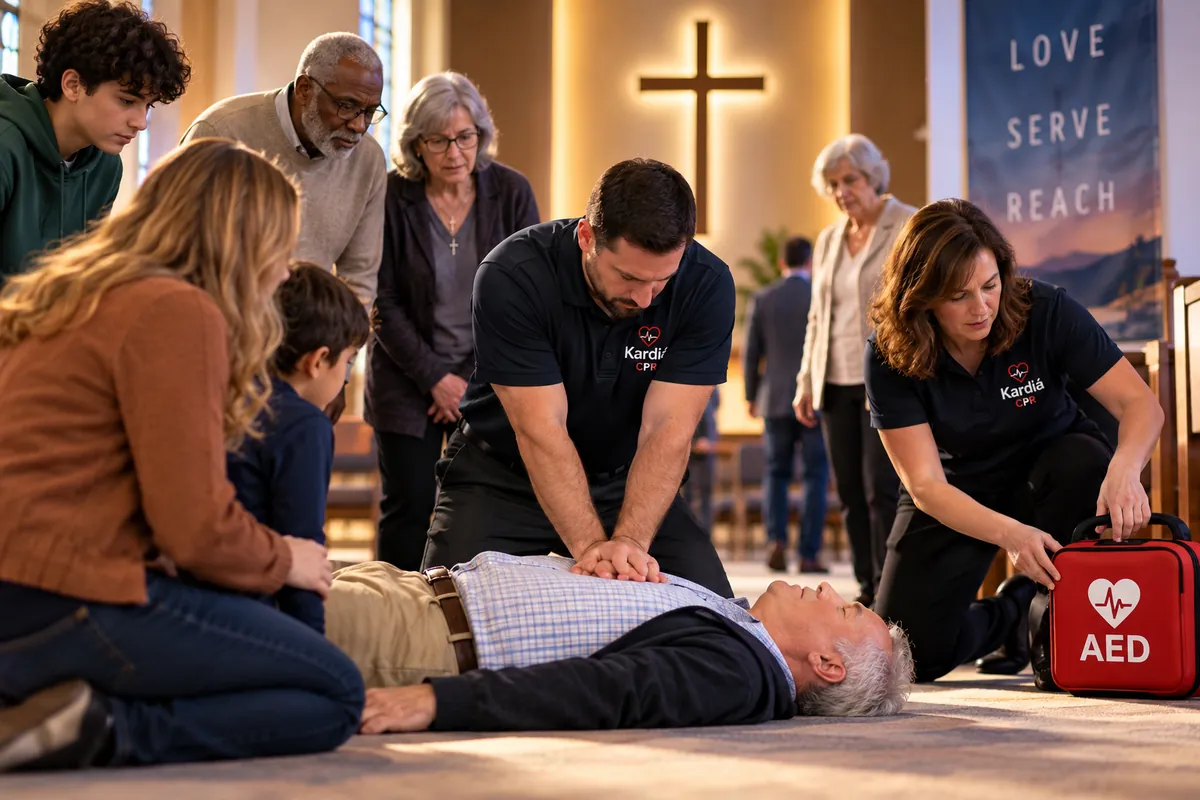
Imagine you're at the grocery store, church, gym, or even a family gathering when someone suddenly collapses.
They're unresponsive. They're not breathing normally. Someone calls 911.
You know CPR. You've even taken a class.
But then you hesitate.
The person who collapsed is a woman.
Suddenly, questions start running through your mind.
Where exactly do I put my hands? What if I accidentally touch her breasts? What if someone thinks I'm doing something inappropriate? Could I get sued?
While those concerns may be understandable, there's something far more important to consider.
Every second spent worrying about how someone might interpret your actions is another second that person isn't receiving potentially lifesaving CPR.
And unfortunately, research suggests this hesitation is a real problem.
The statistics: Women are less likely to receive bystander CPR
According to research highlighted by the American Heart Association (AHA), women experiencing cardiac arrest in public have historically been less likely than men to receive CPR from a bystander.
Women receiving bystander CPR:
39%
Men receiving bystander CPR:
45%
Historical public-setting data from a study of more than 19,000 cardiac arrest cases, as reported by the AHA. These figures are not current nationwide CPR rates.
The same research found that men had 23% higher odds of survival than women in the population studied. This does not mean the difference in CPR alone caused that survival disparity. Other medical and situational factors also contribute.
Source: American Heart Association: Women Need CPR, Too.
Here's the part that should concern all of us.
Researchers have identified fears about inappropriate touching and accusations of sexual misconduct as potential barriers to helping women.
In a study surveying 520 adults about perceived barriers to CPR, when the rescuer was identified as a man:
36.2% of responses ranked fear of sexual assault or harassment accusations as the leading concern.
34.0%r anked fear of touching a woman or having that touch perceived as inappropriate as the leading concern.
These percentages describe respondents' perceptions of what might discourage male rescuers. They do not mean that 36.2% of men actually refused CPR.
Source: Peer-reviewed research: Examining the Impact of Layperson Rescuer Gender.
Think about that for a moment.
Someone could be experiencing a life-threatening emergency, and the person standing beside them may hesitate because they're afraid of doing the wrong thing.
When someone's heart stops, the wrong thing is allowing fear to prevent you from offering lifesaving help.
CPR on women: The technique doesn't change
Let's clear up one of the biggest misconceptions.
Women do not require a different basic adult CPR technique simply because they have breasts.
Your hand placement, compression rate, compression depth, and overall approach remain the same.
If an adult woman is unresponsive and not breathing normally:
Call 911 and have someone retrieve an AED.
Place her flat on her back on a firm surface.
Position the heel of one hand in the center of her chest, on the lower half of the breastbone (sternum).
Place your other hand on top, lock your elbows, and push hard and fast.
Compress at 100 to 120 compressions per minute, at least 2 inches deep while avoiding excessive depth beyond 2.4 inches.
Allow the chest to recoil fully between compressions, minimize interruptions, and use the AED as soon as it is available.
If you're trained and able to give breaths, provide cycles of 30 compressions and 2 breaths. If you're untrained or unable to give breaths, perform continuous hands-only CPR, following dispatcher instructions.
Your hands go on the breastbone, not on the breasts.
You may need to identify the correct position using anatomical landmarks, but the lifesaving technique is the same.
And remember, cardiac arrest is not the same as a heart attack. CPR is needed when a person is unresponsive and not breathing normally, including when they are only gasping.
Source: AHA: Adult Basic Life Support Guidelines.
What about removing a woman's clothing to use an AED?
This is another area where people sometimes hesitate.
An AED is designed to analyze the heart's rhythm and deliver a shock when appropriate. The pads must make direct contact with bare skin.
But here's something important that has been clarified in current resuscitation guidance:
A woman's bra does not always need to be removed to use an AED.
If it can be adjusted to allow correct AED pad placement directly on bare skin, removal may not be necessary. If the bra interferes with correct compressions or pad placement, it may need to be removed.
The priority is to provide effective CPR and use the AED without unnecessary delay.
When possible, have someone shield the patient from public view to preserve dignity and privacy. But never allow concerns about modesty to prevent lifesaving care.
Source: American Red Cross: Defibrillation Guidelines.
Oklahoma's Good Samaritan Law: What if I'm afraid of being sued?
Let's address the elephant in the room.
Or perhaps, in this case, the lawyer in the room.
Some men worry that performing CPR on a woman could result in accusations of inappropriate touching, physical injury, or even a lawsuit.
Oklahoma has a Good Samaritan Act, found inTitle 76, Section 5 of the Oklahoma Statutes.
The law provides certain liability protections for people who voluntarily render emergency assistance in qualifying circumstances.
However, it's important to understand what the law actually says.
Oklahoma's protections depend on the circumstances, including the rescuer's role and the applicable statutory provisions. They are not an unlimited guarantee against lawsuits, and the law does not specifically promise immunity from every allegation of inappropriate touching.
The statute includes protections for qualifying good-faith emergency care, while certain provisions exclude gross negligence or willful or wanton misconduct.
Performing medically appropriate CPR in a genuine emergency is fundamentally different from intentionally touching someone inappropriately.
The best approach is to act in good faith, follow your training, provide only the care necessary for the emergency, and follow instructions from the 911 dispatcher.
Source: Oklahoma Statutes, Title 76, Section 5: Good Samaritan Act.
What if the woman is pregnant? Understanding Left Uterine Displacement (LUD)
Now let's discuss a special circumstance that deserves more attention.
What happens if a pregnant woman experiences cardiac arrest?
First, the most important thing to understand is thatpregnant women still need immediate, high-quality CPR and an AED when indicated.
However, when pregnancy has progressed far enough, an additional technique can improve the effectiveness of resuscitation.
It's calledLeft Uterine Displacement, or LUD.
Why is LUD important?
During the second half of pregnancy, the growing uterus can become large enough to compress major blood vessels when the pregnant woman is lying flat on her back.
These include the inferior vena cava, which carries blood back to the heart, and the aorta, which carries blood from the heart to the body.
This compression can reduce blood returning to the heart and interfere with circulation.
During cardiac arrest, that matters tremendously because CPR is already working to circulate blood manually.
LUD helps relieve pressure on those major blood vessels, supporting blood flow while chest compressions continue.
The AHA's 2025 guidelines recommend continuous LUD during cardiac arrest when the top of the uterus (fundus) is at or above the level of the belly button, generally around 20 weeks of pregnancy or later.
Source: AHA 2025: Special Circumstances of Resuscitation.
How is Left Uterine Displacement performed?
LUD is best performed by a second trained rescuer while another person continues chest compressions.
The pregnant patient remains flat on her back on a firm surface, allowing high-quality CPR.
The second rescuer gently but firmly moves the enlarged uterus toward the patient's left side, away from the major blood vessels.
This can be done using the appropriate one-handed or two-handed technique, depending on where the rescuer is positioned.
The goal is to maintain displacement throughout resuscitation without interrupting chest compressions.
Important:LUD is not pressing down on the abdomen, and it is not a replacement for CPR.
If you're the only rescuer, don't delay chest compressions to attempt LUD. Begin CPR, call for additional help, and follow emergency dispatcher instructions.
This is one reason hands-on training and coordinated emergency response are so valuable.
Does LUD help the baby, too?
Potentially, yes.
The first priority during maternal cardiac arrest is restoring circulation to the mother. Improving maternal circulation also supports the possibility of oxygen delivery to the baby.
However, LUD is not a guarantee of survival for either patient. It is a recommended intervention supported by physiological evidence and resuscitation research, not a substitute for rapid advanced medical care.
And yes, an AED can be used on a pregnant woman when indicated.
Pregnancy is not a reason to withhold CPR or defibrillation.
Source: 2025 AHA Cardiac Arrest in Pregnancy Algorithm.
Knowing CPR and being prepared to perform it are two different things
We live in a world where nearly anything can be learned from a video, website, or social media post.
And those resources can be helpful.
But there's a big difference between watching someone perform CPR and actually practicing it yourself.
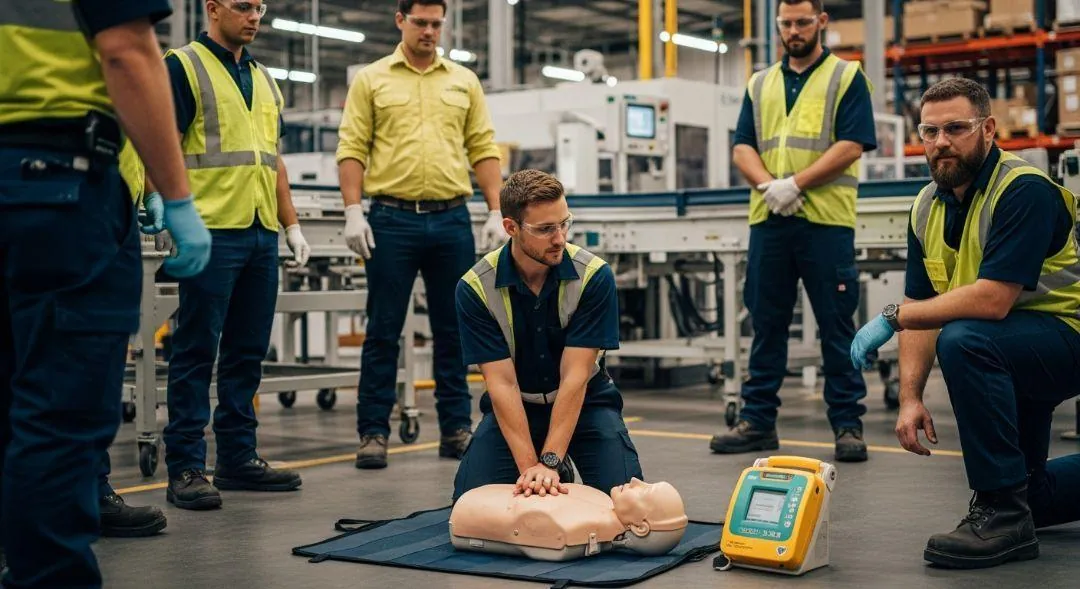
An in-person CPR class gives you the opportunity to practice hand placement, compression depth, rate, AED use, and working with other rescuers.
More importantly, it gives you the chance to ask questions.
Questions like:
What if the person is a woman? What if she's pregnant? What if I'm afraid I'll hurt her?
Those are exactly the kinds of questions that deserve answersbefore an emergency happens.
Research reflected in the AHA's 2025 resuscitation education guidelines recognizes that fears about inappropriate touching, sexual assault accusations, and causing injury can create barriers to providing CPR to women.
Training that directly addresses these concerns can help rescuers understand what appropriate care looks like.
Source: AHA 2025: Resuscitation Education Science.
Someone's life is more important than our discomfort
Think about the women in your life.
Your wife. Your daughter. Your mother. Your sister. Your coworker. Your best friend.
If one of them suddenly collapsed, wouldn't you want someone nearby who knew what to do?
Someone willing to call 911, begin compressions, and use an AED?
Someone who wouldn't hesitate because they were worried about what others might think?
I certainly would.
Every woman deserves the same opportunity to survive cardiac arrest as every man.
Not because she's someone's wife, mother, or daughter.
But because her life matters.
And sometimes, the difference between hesitation and action is simply having the knowledge, practice, and confidence to respond.
Oklahoma, are you ready to make a difference?
AtKardiá CPR, we believe CPR training isn't just about earning a certification card.
It's about preparing ordinary people to do extraordinary things when someone needs help.
Whether you're a parent, babysitter, teacher, coach, healthcare worker, business owner, or someone who simply wants to be prepared, there's a CPR class for you.
Kardiá CPR offers hands-on training throughout Oklahoma, including American Heart Association and HSI courses.
Our classes are designed to help you understand not onlyhowto perform CPR, butwhyit works and how to respond confidently in real-world emergencies.
Don't let uncertainty decide whether someone gets a chance to survive.
Get trained. Get confident. Be ready.
Because when someone's heart stops, their life may literally be in your hands.
Ready to learn CPR?Contact Kardiá CPR to schedule your class or arrange training for your Oklahoma business, church, school, or organization.